Escalations | A Practitioner’s View
Escalation is a phenomenon in which an organization or other acting entity persists in pouring resources into a failing course of action. In general, the escalation literature assumes a close interrelationship between escalation of a course of action and escalation of individual and organizational commitment to this course of action. Escalation is seen as occurring through a series of decisions favoring persistence and thus, it is frequently seen as resulting from flawed decision making at the individual or group level. Additional characteristics of escalation situations include an opportunity to persist or withdraw and uncertainty about the outcomes of decisions.
| Factor Types | Description | Examples |
|---|---|---|
| Project factors | Concern the objective features of the project and how decision makers perceive these features. | Projects are more prone to escalation when they involve a large potential payoff, require a long-term investment to be profitable, and are costly to abandon and when setbacks are perceived as temporary problems that can be overcome |
| Psychological factors | Cause managers to convince themselves that “things do not look so bad” | High personal responsibility for the project outcome, visible personal attachment to the project, prior history of success, and information-processing errors (cf. prospect theory) are psychological factors that promote escalation |
| Social factors | Stem from the social environment that can hold the decision maker(s) to a course of action even after their personal beliefs no longer justify it | A group’s competitive rivalry with other groups, a group’s modeling of behavior after another group, the need for external justification (resulting from leading external stakeholders’ belief in project success) and behavioral norms that favour “staying the course” are all factors that increase the likelihood of escalation |
| Structural factors | Concern the political and organizational context of the project | These include political support for the project, and administrative inertia and tie-in with organizational objectives and values. They also include external political support and external pressure to persist |
ANT - summary
I have previously written about Actor Networks, but I will briefly summarize the gist of what happens at the controversy line.
The creation of an actor-network, also referred to as translation, consists of four major stages: problematization, interessement, enrollment, and mobilization. Before discussing the details of each stage it should be noted that all translation processes do not pass through all these stages and that translation processes may fail and halt at any stage.
Translation is defined as the methods by which an actor enrolls others into his programme. These are achieved through -
During the problematization stage, an actor initiating the process defines identities and interests of other actors that are consistent with the interests of the initiating actor. In this initial stage in building an actor-network certain actors position themselves as indispensable resources in the solution of the problems they have defined. They define the problems and solutions and also establish roles and identities for other actors in the network. As a consequence, initiators establish themselves as an obligatory passage point.
The second translation stage is interessement, which involves convincing other actors that the interests defined by the initiator(s) are in fact well in line with their own interests. This also involves, if necessary, creating incentives for actors such that they are willing to overcome obstacles in the way of becoming a part of the actor-network. Successful interessement confirms (more or less completely) the validity of the problematization and the alliances it implies.
If interessement is successful, enrollment occurs. Enrollment involves a definition of roles of each of the actors in the newly created actor-network. It also involves a set of strategies through which initiators seek to convince other actors to embrace the underlying ideas of the growing actor-network, and to be an active part of the whole project. In other words, it is the group of multilateral negotiations, trials of strength and tricks that accompany the interessements and enable them to succeed.
The fourth and final stage of translation, mobilization, includes initiators’ use of a set of methods to ensure that allied spokespersons act according to the agreement and do not betray the initiators’ interests. Building on a set of enrolled actors, initiators seek to secure continued support to the underlying ideas from the enrolled actors. With allies mobilized, an actor network achieves stability. This stability would mean that the actor-network and its underlying ideas have become institutionalized and are no longer seen as controversial.
In addition to the four stages of translation, the process of inscription is critical to building networks, as most artifacts within a social system embody inscriptions of some interests. As ideas are inscribed in technology and as these technologies diffuse in contexts where they are assigned relevance, they help achieve socio-technical stability. Inscription takes place in the formation of a technology and in the placement of this technology in an actor-network. This means that the technology does not have to be “implemented” for it to exist. It has to be conceived, but once it is conceived it is a force to be reckoned with: it is an actor. Inscriptions prescribe a program of action for other actors, which the latter may or may not follow, depending on the strength of the inscription. In relation to translation, inscription to a large extent takes place simultaneously and interrelatedly; it starts as soon as a technology enters the picture and is beginning to be formed by its creators.
Another important phenomenon and concept of ANT is irreversibility. Irreversibility refers to the degree to which in a certain situation it is impossible to go back to a point where alternative possibilities exist. Irreversibility is often the result of the inscription of interests into technological artifacts, whereby those interests become increasingly difficult to change.
There is often more than one relevant network in relation to complex IT-related change efforts network: disconnected networks (networks that are unrelated and unaligned), gateways (links between two actor-networks that are unable to establish direct interaction), and polyvalent networks (distinct but partly overlapping actor-networks joined through certain multi-attaching, or polyvalent nodes).
Visualization and Mapping
I personally prefer to think with a pen and paper, for thinking without interruptions. And when I reach some natural stopping point or pausing point, I then dump my thoughts onto a reader friendly file format like PDF or PPT. The main thing which usually irks me in this exercise is that I can’t use the words which I have regularly used in the posts, as most clients are unfamiliar with the concepts outlined. And rightly so, after all they paid for getting the job done, not for understanding my thought process. With this constraint in mind, the best way to explain anything is to not use words at all. Use images and visualizations instead. So I will not explain the “money shot”, which as a manager is very important. For you need to unite a group of people behind your vision, such that you retain control while simultaneously fully transmitting the central message(s).
I find that one can de-escalate a situation only if one knows how to escalate a situation. Let’s first talk about representing the escalations, and then later talk about de-escalation possibilities. I find that if I can clearly visualize and therefore convey the escalation, then the solutions towards de-escalating instinctively start appearing as well.
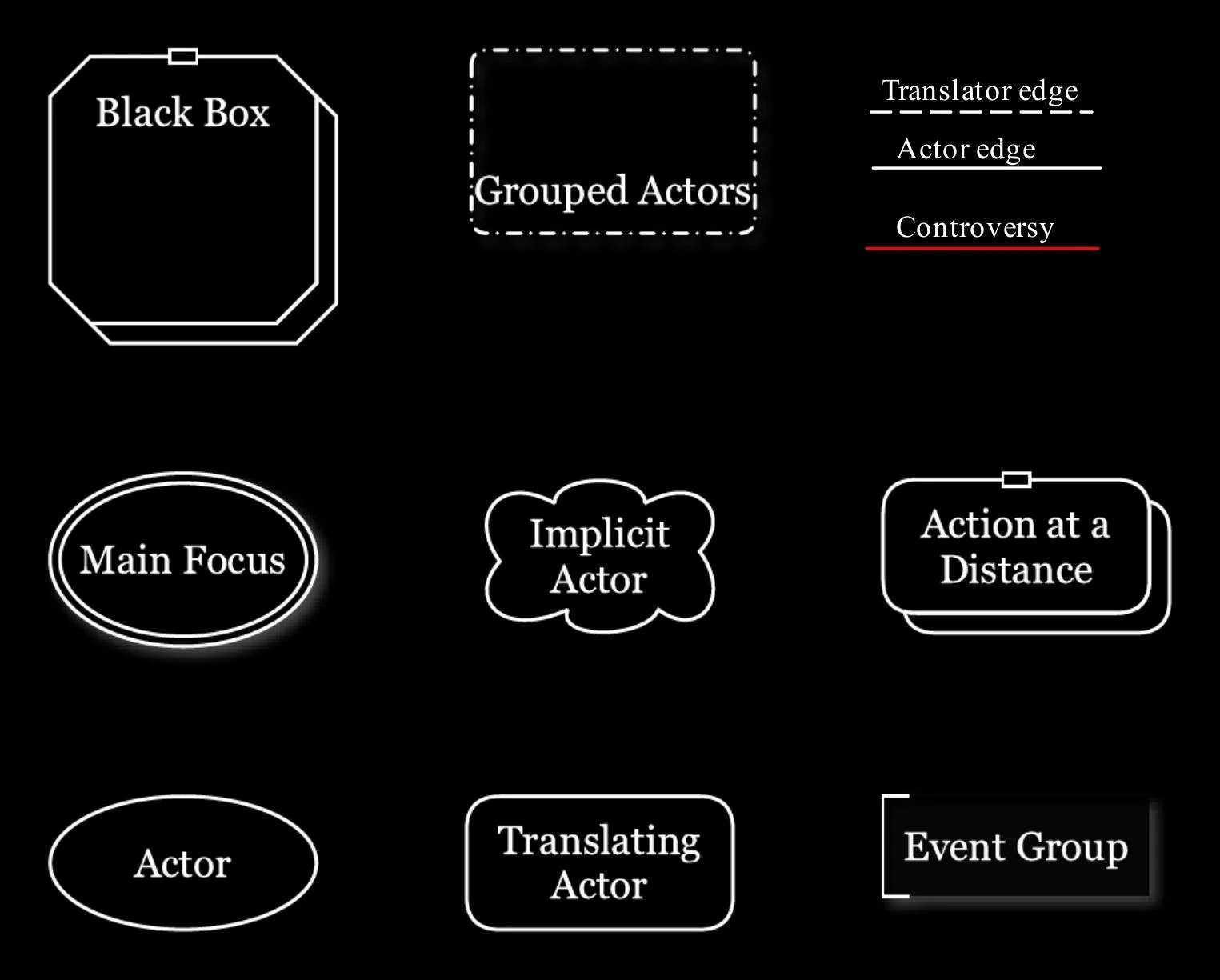
Legends for Graphical ANT
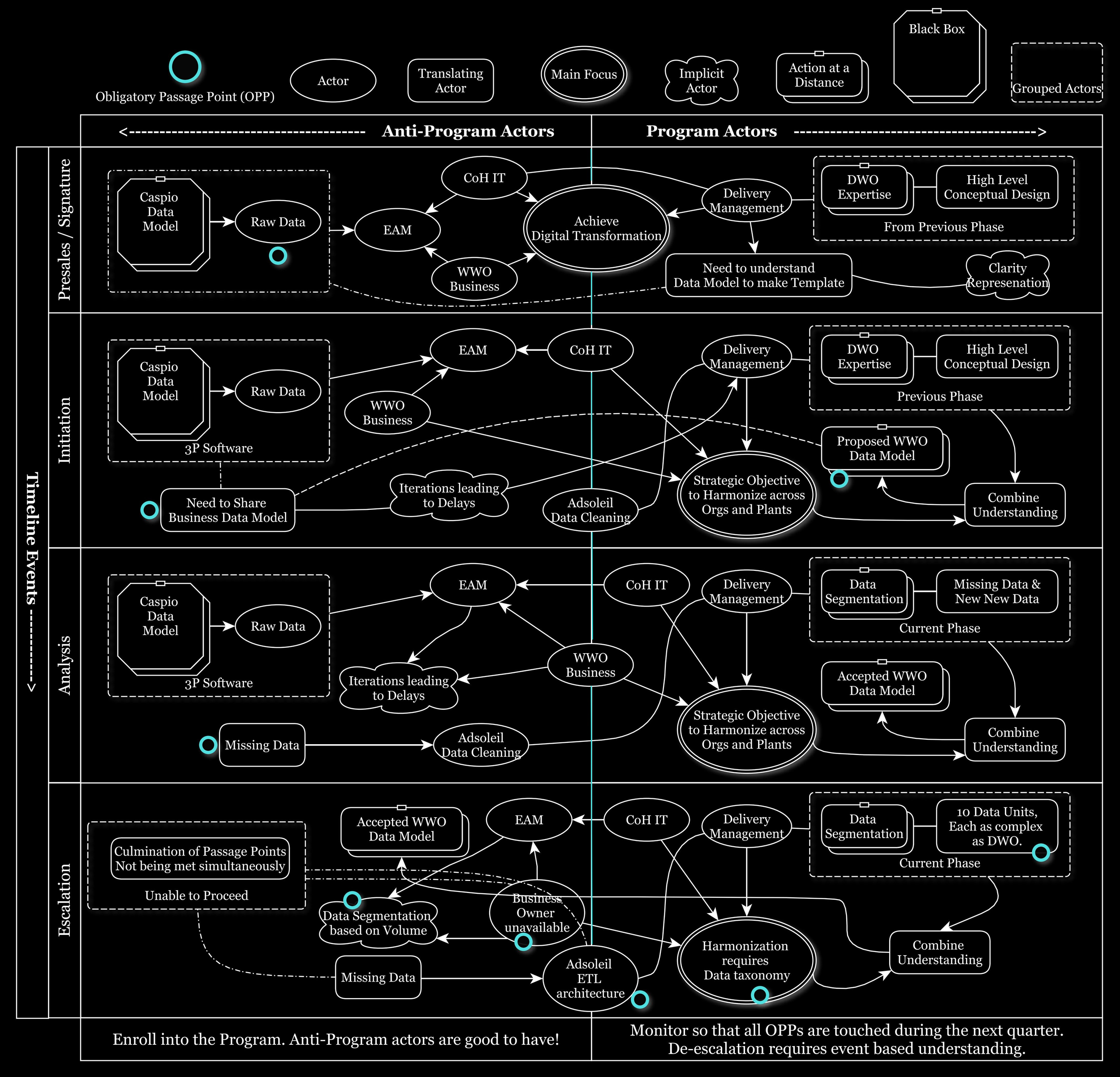
Image Showing the Analysis of ANT concepts in understanding the Escalation on a timeline of Events.
De-escalation Process
In the following sections, I will go through each of the below topics one by one. I suggest you adapt these thought processes in your de-escalation quest.
Knowledge Cartography
Narrative Maps in Sensemaking
Transition to IS Projec De-escalation Managers Behaviour
Game Theory for Managers - Multi person power coalitions
Rethinking Project Escalations
When Good theories Backfire
Digital Transformation Canvas Visualization
Agile Digital TRansformation and Visualization
PM Strategic Decision Making Visualization
Visualization of Time Oriented Data
Diverse Stakeholder Decision Framework
KNOWLEDGE CARTOGRAPHY
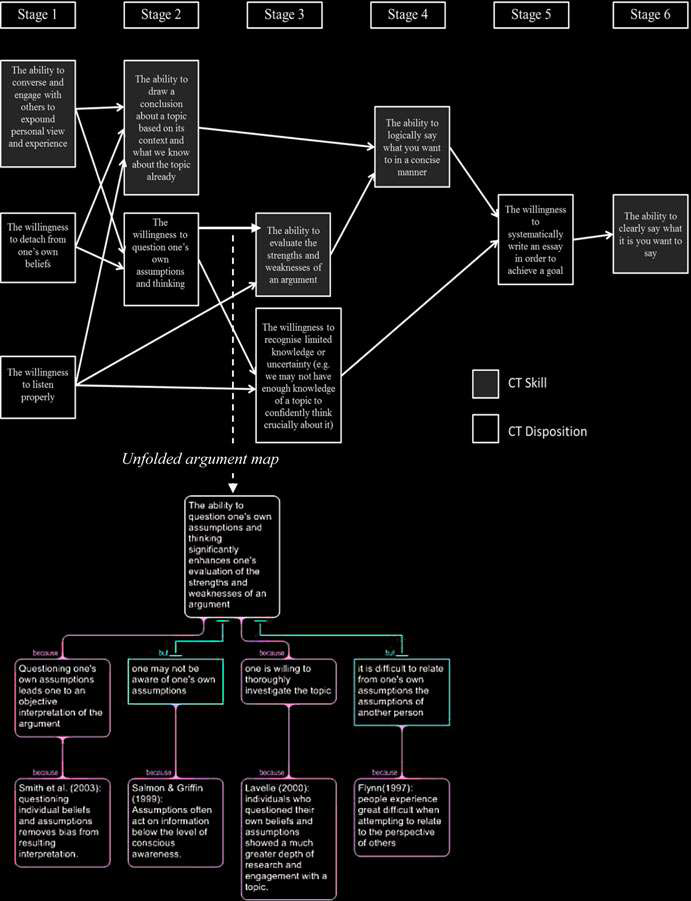
This is a whole subject in itself, so I will choose the subset which is most applicable to de-escalation. As such we will focus on Argument Diagramming and, Integrating Argument Mapping with System Thinking.
Standard diagrams support the notion of a refutation, which is an argument that refutes or argues against another node in the diagram. In propositional logic, the notion of refutation is that for a given statement P, there is a statement not-P which is the logical opposite of P. Since each statement can have only one logical opposite, the standard diagram allows only a single refutation for any given node. In a “real” argument, there could be a number of arguments against a given proposition. In the standard diagram, such a situation is represented by creating the single refutation node for the proposition which is to be refuted, and then to draw in the various arguments against the proposition as supports for the refutation. Each argumentation scheme is usually associated with a set of critical questions which should be answered in order to verify the validity of the argument. In a natural argument, some propositions will have greater validity or force than others. In a standard diagram, a force can be represented as an evaluation of the support line connecting a proposition with its conclusion. A Toulmin diagram provides the rebuttal as the mechanism for rebutting an argument. A rebuttal appears as another node that links into the DWC by a vertical line from below. The fact that the rebuttal also impacts on the link between datum and claim shows that it attacks the inference from datum to claim, rather than being a strict negation of the claim as is the case with the refutation node in the standard model. The final feature in a Toulmin diagram is the qualifier. A qualifier plays roughly the same role as an evaluation in standard: it provides a measure of the confidence in the DWC complex.
I suggest the reader to engage in diagramming the as-is situation before engaging in analysis. Once you have setup the diagrams and are ready to link the problems together, you will see the emergence of an Actor Network, in this case a Trojan Actor Network because you will have found the set of circumstances that lead to the escalations in the first place along with the arguments for the existence of this network and set of problems. In a sense your fight is going to be against this entire network. You can do so by the process of enrolling the Anti-Program actors in your favour by use of rational logic, show of strength, by authority and by diplomacy.
I want to focus on the types of rebuttals, as these are essential while de-escalating when your opponents are rational actors.
1. The rebuttal refutes the claim directly.
2. The rebuttal refutes the warrant directly.
3. The rebuttal supports a premise that refutes the claim.
4. The rebuttal refutes a premise that supports the claim.
And I also want to spend some srceen real estate on testimonials, which play a vital role in de-escalations as you will be collecting oral data during your interactions with all your stakeholders. A testimonial or circumstantial evidence node in a Wigmore diagram may have up to three supporting groups of nodes: other testimonial or circumstantial evidence, explanatory evidence and corroborative evidence. In a sense, you want to fortify the evidence which is in your favour by using it to counter the counter-narrative, and to weaken the evidence against your position by rebutting wherever possible.
Unfortunately, diplomacy is a skill which cannot be taught in my view, but in a future post, I will write about that as well. In the meantime, below is the integrated Critical Thinking and resulting Argument Mapping done in a generic sense so that a System Thinking approach can be easily taken while engaging in a de-escalation exercise.
A key point which I want to re-inforce : Escalation is itself the result of a stable Actor-Network that would support Escalation Behaviours. These networks has a coalition of interests which you must identify. Enrollment concerns the negotiation of roles between actors in the actor-network under formation. Closely interlinked with interessement, enrollment was partly expressed through the negotiations and agreements about terms and conditions. Translation processes are dynamic and emergent processes; a single actor does not hold a privileged position over – or control of – the development of events. Rather, different groups of actors compete in “trials of strength”. The basis for mobilization is the existence of enrolled actors. These actors may well retain their own specific agendas; they need only find it worthwhile to be part of the network on the basis of alliances concerning one or a few specific issues. Once the web of alliances is in place, it becomes possible for some actors to speak on behalf of a whole cause (i.e. to mobilize the action of an entire network). The embedded Trojan Actor Network is to be fought against, which de-facto means that you must fight against the “Stable” Equilibrium.
These Trojan Networks are akin to viruses which are ultimately fatal to the host. Often times you will see these networks existing in the Consulting Organization and they kill off one Project after another. This can ultimately lead to the death of the Consulting Organization itself. If you get enough actors enrolled, then at some point the anti-virus system will also spring into action. These include those actors who had accepted the status-quo but because of the renewed confidence in attaining a common goal are ready to take a last stand against this terminus of mismanagement. It should be noted, however, that escalation occurs because translation is strong during a time period, although geared toward goals that are ultimately found to be unrealizable. Weak translation that fails at early stages would in terms of escalation theory be a “functional” or “correct” abandonment of a failing (or “dysfunctional”) course of action at an early stage.
Narrative Maps in Sensemaking
Narratives are unstable and shifts from one equilibrium to another. The equilibrium is a dominant narrative that is generally accepted as a universal truth. The stories people say that offer resistance to, either implicitly or explicitly to the dominant narrative are called counter-narratives. The boundary between dominant and counter-narratives is not fixed, and they are always less stable and unified than they appear. With time and effort, counter-narratives can potentially change the dominant narrative. In the process of creating the counter-narrative, individuals reference the dominant narrative and position themselves against, or in contrast to it. Setting up a narrative can be for endorsing the vested interest of the stakeholder group. People of reputation play a key role in setting up narrative through trust transference. A counter-narrative contests the narrative which are set up by the promoters. Again, people of reputation play an important role in setting up the counter-narrative as only narratives backed with referent power. Hence, there is an ongoing process of multiple negotiations and contestations of meanings, values, identities, and images, fought through multiple battles of narratives in megaproject settings. The counter-narrative is also subject to contesting by the promoters and protesters of the project. the project narrative of the need for the megaproject is dynamic and travels through multiple rounds of narratives and counter-narratives. Thus, the project narrative is a result of the interaction between narratives and counter-narratives as shown.
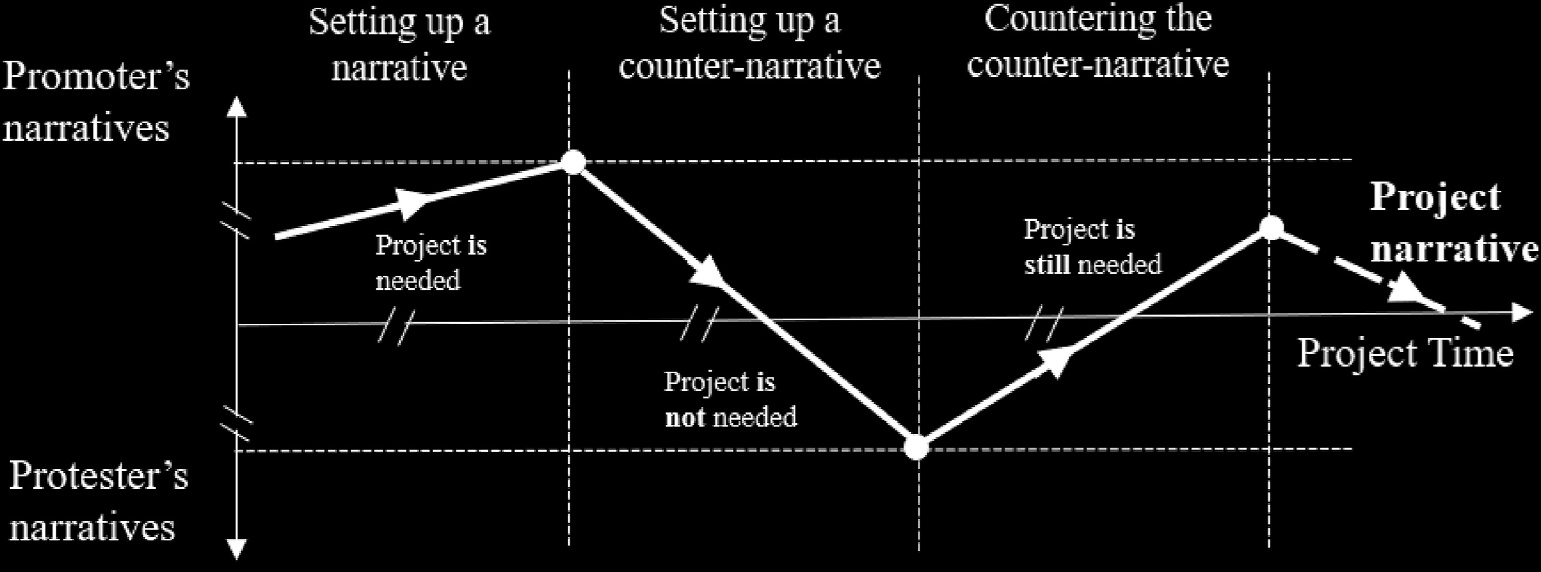
Below is a real world example which I wrote down in my notebook to share with the Technical Lead on one of my projects.
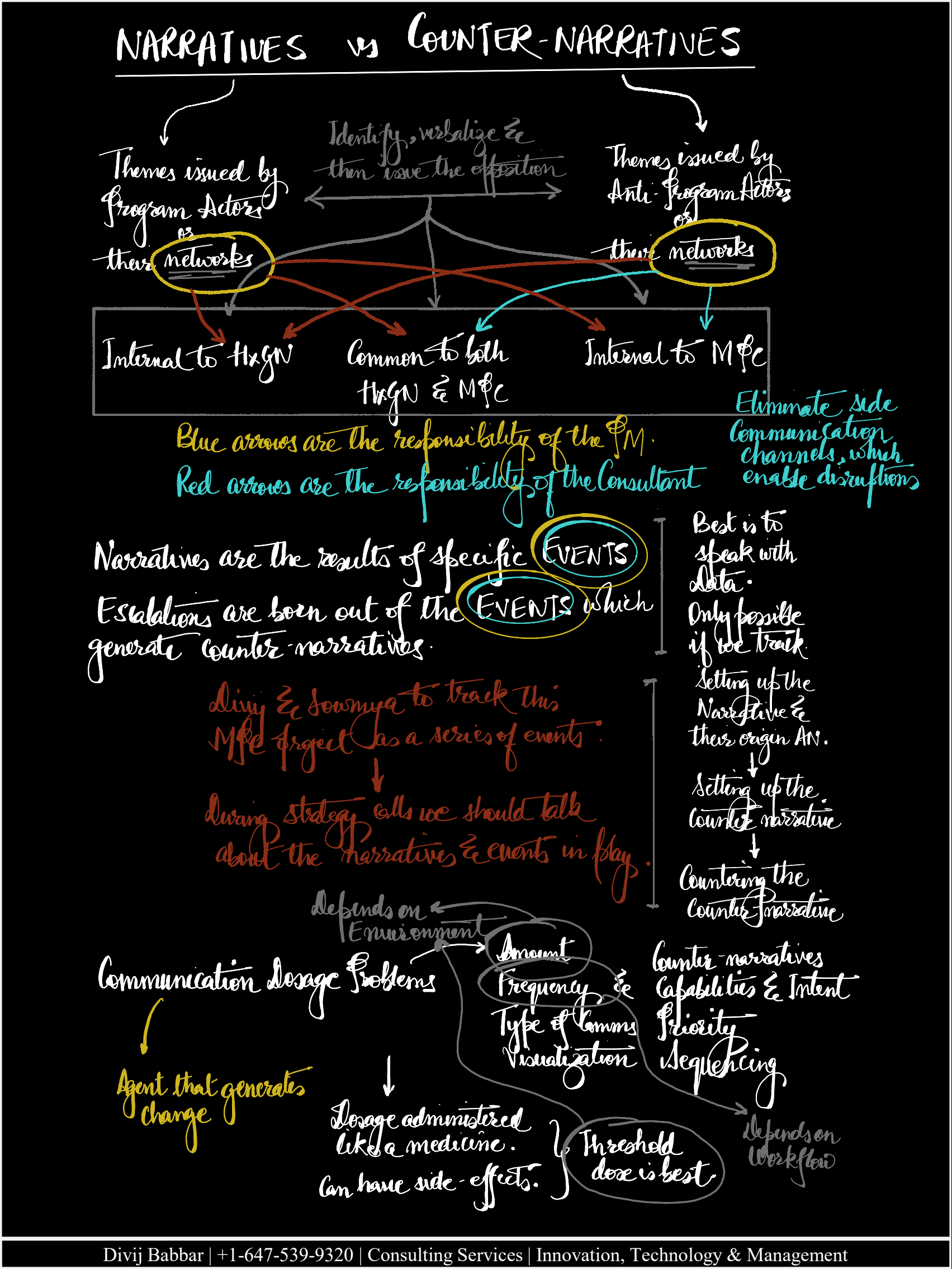
You can see that this entails an endogenous and an exogenous approach to identify, the actors / events / networks and their resulting narratives in a project. I have further sub-divided amongst myself and the Tech Lead the responsibility of who is to identify which network. In fact, in most of the client meetings I simply use the insights resulting from such an analysis to present the forward direction.
This is turning into a long post… I will continue in a subsequent post later on….