Introduction to ANT for Project Leaders
Introductory comments
All new concepts, products and processes must undergo long and enduring trials during which various coalitions of actors dispute the veracity, usefulness, value of a given hypothesis, concept or device which is still in the making. The process of establishing the truth of a scientific claim or of a potential innovation involves a front line (the controversy front) around which the opposing coalitions of heterogeneous actors battle out various questions. Scientific facts are strong and innovations are robust only because they have been subjected to so much counter argument and counter examination. AI is currently in the emergent and exploratory phase where such counter arguments and counter examinations are happening and the dominant design is not yet clear. Thankfully we have a model through which to analyze the environment or stage on which all these interactions take place, which is called Actor Network Theory.
ANT was initially developed and used for “socially explaining hard scientific facts”. It describes how science and technology work by studying “trails of associations between heterogeneous elements”, and “the tracing of associations”, which may include “any type of aggregate from chemical bonds to legal ties, from atomic forces to corporate bodies, from physiological to political assemblies”. It defines itself as a “small subfield of social theory”. From the start ANT has had all the resources to put itself more at the service of project management but instead its energy has gone into science and technology policy (by contributing the concept of research networks), political science (via the mapping of technoscientific controversies) and now into providing an “alternative social theory” to the “sociology of the social”. All of this is very fascinating, but how does this pertain to what this paper is going to be about? The reason I introduce this ANT lens, is because I view the technoscience and management of technology worlds through this prism. Why I choose to do so, will become clearer (hopefully) in the next couple of explanations.
There is a similarity between the process of pushing a claim from fact to fiction and that of undertaking a project, from a state of non-material being (initial idea) into a state of material being (final deliverable). Like the fact builders of science we all want our projects to become nicely working black boxes that no one has to tinker with, unravel, reopen or adjust. Like them we want our finished projects to become obligatory passage points (commonly referred to as OPP) for other actors. These and other ANT terms will be explained in the following section.
If the concepts, products and processes survive to become “classics”, like the DNA model or the i-Pad, they become what are called black boxes in Actor Network Theory. Black Boxes are essentially non controversial parts of our everyday environment. As society becomes more sensitive to the potential risks and hazards of science and technology, public policy makers and even corporate boards are becoming more prudent and turning to controversy description and mapping as part of their strategy formulation and project selection and piloting processes.
The past decade has seen the rise and fall of Agile. Agile is in my view a highly debated term, and its lack of definition or proper paradigms which hold true to the generally accepted definitions effectively means that there are as many viewpoints of what is Agile and what is not as there are people who utter this term. Heralded as the solution to all the woes of a tech company, unfortunately Agility has done much more for the consultants who claim expertise in this subject. Yet, it is a good example of how a claim moved from fiction to fact, and in the process of so doing was able to enroll all the anti-programme actors.
building black boxes : moving from fiction to fact
ANT allows us to describe and track the status of scientific claims (“this could be an explanation for dark matter”), technological claims (“this could be the best system for allowing cars to drive automatically in all conditions”) and socio-technical claims (“vaccines are not dangerous for your health”) by paying attention to the interactions of human and non-human actors. The person seeking to turn a ‘claim’ into a ‘fact’ (a widely accepted theory of dark matter, a universal system for driverless cars, the acceptance by one and all that vaccines are as safe as pure spring water) does so by building up networks which must tie and maintain together whatever actors are necessary for the astrophysicists, car passengers, public health doctors etc. to consider that these facts/machines/assurances are as reliable, perfect and unflawed as a 24K Gold, which ANT prefers to call black boxes. Scientists and engineers strive to build facts and machines that will become black boxes.
ANT has been constructed empirically by looking at and telling many stories (cases, accounts) of how such black boxes were made or failed to be made. Science and technology were (and still are being) observed in situ and in the making. ANT shows us that fact construction, fact writing, or black box building requires very stormy conditions in order to work. Dissenters, disbelievers, counter laboratories – other actors – invariably get in the way and try to weaken, shake, disassociate the connections and untie the supply lines. Whenever and wherever new products, processes, services are being developed controversies abound. Networks of fact and machine building are in conflict with other networks of fact and machine building.
These trials of strength between claims and counter claims are enacted on a daily basis in informal discussions, workshops, seminars, congresses, whitepapers, blogs (such as this!) academic journals, boardrooms, government agencies, standards organisations, expert committees, courtrooms and parliaments. As you may have guessed looking at the state of AI today, that all these trials of strength are indeed happening, and we are in a stage where ANT makes sense to be used as a tool to analyze. Those pushing claims along the fiction to fact dimension invariably and naturally encounter resistance and opposition from haphazard and/or organised assemblages of actors. This resistance is overcome on the one hand by adapting the claim (concept, prototype, project) to make it more acceptable to the opposing actors (cracks start to appear in the fuselage so you use a stronger alloy, although this will make the plane heavier and costlier to operate than promised; you add a marketing expert to the board so that venture capitalists will invest more in your start-up).
On the other hand opposing actors may be persuaded to change camps. In the first case, you align your interests to theirs, in the second case they align their interests to yours. Either they enroll you or you enroll them. And now hopefully you see why developing and formalizing this notion further may lead to a fantastic tool to use for both Operations and Projectized management. The evolution of this constant tug of war between elements of the programme (supporting the claim) and antiprogramme (opposing the claim) can be shown on a sociotechnical diagram which represents (horizontally) associations of relevant programme or antiprogramme actors on either side of the controversy front and substitutions (or new combinations of actors) on the vertical axis. Each horizontal line is both a new version and a new phase of a project. In my own practice, when speaking to the C-Suite all my presentations are done on an ANT based paradigm.
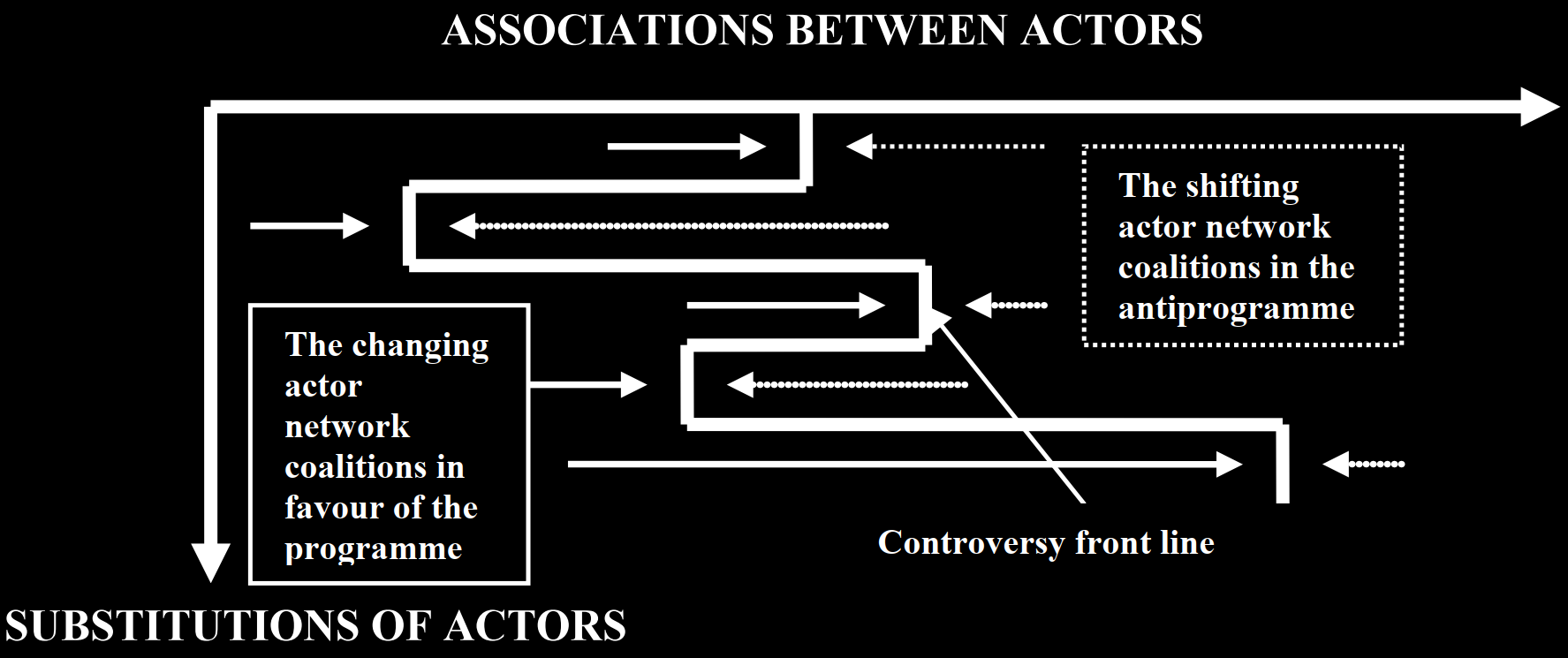
In the above figure we can see the effectiveness of dealing with a rapidly changing environment especially when our job as the leader is to live on the controversy line.
Importance of AntiProgramme and Boundary Objects
In this ANT view, the antiprogramme opposition at any given phase of a project is not just an external irritant to be neutralised or negotiated with. It is part and parcel of the project. Without opposing human and non human actors the next phase will not be possible, they are like the stones that will lead Hansel and Gretel out of the dark and dangerous forest. No controversies mean no future black boxes! Experienced Directors know this instinctively, which is why in most Steering Committees and/or Executive Strategic Sync meetings the agenda most often revolves around the antiprogramme opposition and how to control it, whereby reducing the overall risk but still maintaining the sense of urgency required to reach a black box.
As Managers it is vital not to lose those actors opposing the antiprogrammes on the left hand side of the controversy front. For the intended programmes to be successful, it must continuously remain the obligatory passage point (OPP) for both the outside, i.e., the exogenous network (i.e., the network of human and nonhuman actors which carries out the project), and the inside, i.e., the endogenous network (i.e., the network which experiments, tinkers, assembles and provides the actors in the outside network with the material, economic, cultural or symbolic return on investment they expect). It is the role of power promoters and relationship promoters to look after the endogenous network (SVPs, Partners etc.), while the technical promoters and process promoters are taking care of the endogenous network (Directors, PMs, Consultants, Analysts etc.). These four roles would be compatible with ANT if it could be shown that the promoters were acting as spokespersons for various parts of the network by skillfully translating their interests.
Boundary objects (commonly referred to as BOs), act as network connectors allowing endogenous actors to cooperate and to be coordinated whilst keeping their differences and preserving their autonomy. The solutions invented by the actors in context would seem to be of two types: the standardization of methods and the development of boundary objects. And this concerns abstract or concrete objects, whose structure is sufficiently common to several social worlds to ensure minimum identity in terms of the intersection whilst being sufficiently flexible to adapt to the specific needs and constraints of each of these worlds. These boundary objects are supposed to maximise both the autonomy of these social worlds and communication between them. The notion is therefore closely linked to issues of shared meaning and interpretation. It supposes the existence of a minimal structure of knowledge which is recognized by the members of the different social worlds, which can take very diverse forms: the malleable object which can be shaped and shared by the same boundaries with different internal forms such as the conventional boundaries of a region; the library object from which each individual can take what he or she needs, thus acting as a repository of information; the abstraction object which can be simplified as an abstraction (a general model which abandons local or singular specifics such as, for example, the notion of species which can be adapted and completed by different participants in the collective action area), allowing us to ignore the properties we do not need; and finally, the interface object or exchange standard, which facilitates communication and the grouping of diverse content. Thus it is fair to say that a generalized BO facilitates dialogue between worlds, makes several activities possible, can be modular and its different parts can serve as a basis for internal and external networks, and thanks to its standardized form renders the information penetrable.
Boundary objects correspond to the desired functions of the product/process/service. Given that the networks they are connecting have different identities and so do not see the boundary objects in the same way we should allow boundary objects to be fuzzy at the beginning so as to be better explored and then to stabilize progressively through controversies and compromises. As an analytical tool, the boundary object does not only report on connection processes but also on the weight of inertia affecting communication infrastructures. Transparent and invisible, they can be made visible through shortcomings, changes or tests, in particular during the innovation phase where the boundary object copes with existing architectures of the social worlds.
The management of knowledge at the boundary would thereby entail three types of activity -
Transfer: management of formats (pipes, syntax, management of information, etc.). It corresponds to situations where the relationship is stable and where there is a shared repertoire.
Translation: when it is impossible to forecast or there is change, or meanings cannot be determined (unknown, ambiguous or different); when there is interactivity (mediation, joint activity, etc.). The result is translation from one register to another, explanation and confrontation of points of view, construction of acceptable compromises and shared visions. The boundary object thereby becomes a “cognitive” mediator; it constitutes a transaction zone for the perspectives in attendance.
Transformation: when the interests of actors diverge, there is negotiation of interests and knowledge, and construction of a compromise. At this point, the boundary object becomes a “social” mediator where there are issues of power and allegiances, exchanges of contributions and identity.
Managing an innovation project can be seen as managing the dialectic between boundary objects and obligatory passage points. Inside the innovation project are boundary objects (which themselves are existing at the boundaries of the social worlds and the exogenous and endogenous networks); and outside the innovation project are obligatory passage points. They co-evolve. Choosing certain boundary objects means accepting particular obligatory passage points, acting on BOs redefines the OPPs.
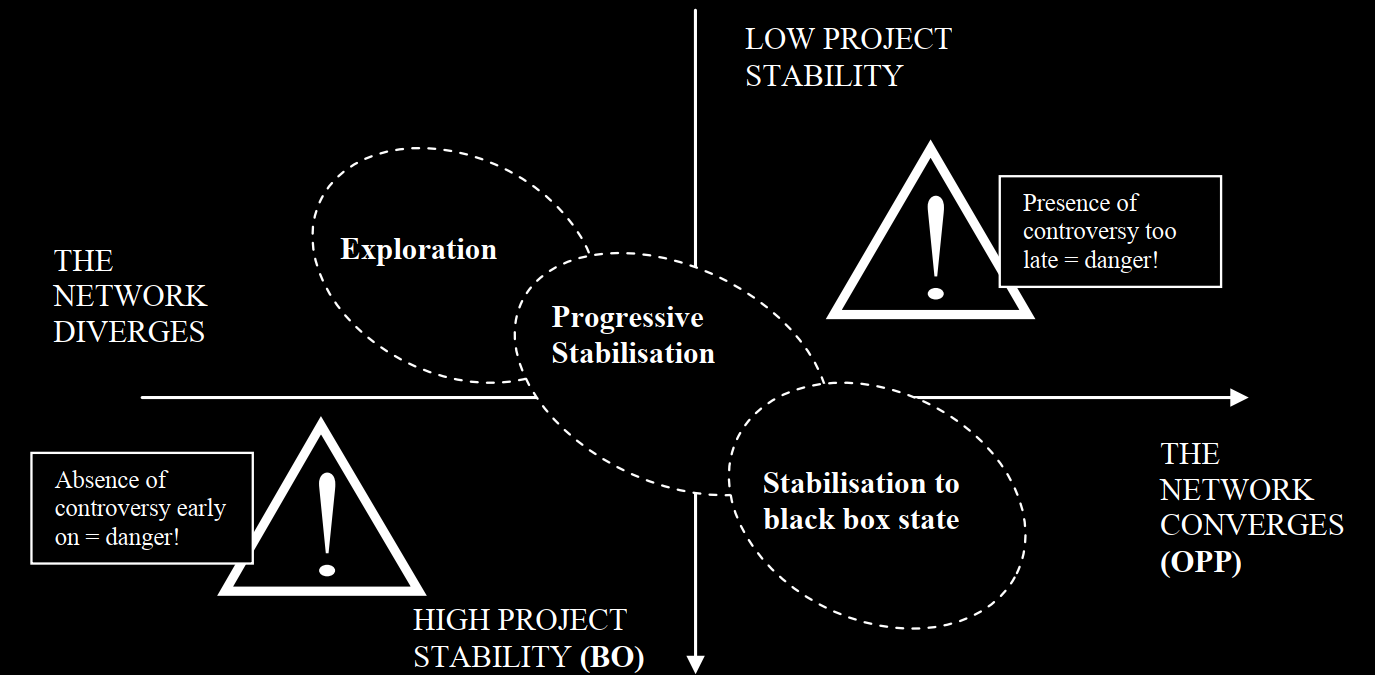
The above figure shows the ideal project phases : exploration, progressive stabilization and stabilization to black box state. In the first phase it is important not to over-stabilise the project. Lack of humility often engenders insufficient exploration of possible technologies, possible markets, production constraints, possible alliances. Secondly, it is important to actively look for and bring out into the open rather than hide the controversies that destabilise the project at the beginning. Consensus about boundary objects at the outset will lead to divergence, conflict and delays later on. Likewise by choosing reassuring user representatives we are favouring the project’s internal coherence as opposed to its coherence with the environment. The main message to the Hansel and Gretel’s of innovation management is to make sure they get lost in the forest early on in the project so that they can meet and tame the wolf cubs. Not doing this means running into wolves later on and then it will be too late!
ANT based management of innovation projects
I believe that it is in our collective interest to clarify the dynamics of the project management field, to start identifying the relevant actors, to start tracing the associations linking them or separating them, to identify the clusters, to pinpoint the social, technical and economic issues at stake. Applying controversy mapping to any given individual innovation project, or to a field or domain of projects is the main contribution of ANT, in my view. The approach is based on a learning pact between the “innovator” and the “evaluator”, (we could say between the project team and the project sponsors). The aim is to determine the quality of the project’s learning trajectory. The project sponsors should require the team to come up with continuously risky descriptions (rather than reassuring ones) of the project at regular intervals. The innovator-evaluator duo compares the evolution of the project at regular intervals using four families of ANT indicators designed to ensure that the successive descriptions stay rich and avoid falling into the trap of inappropriate project management. The four pathologies and the countermeasures are summarised below -
To know if the project is \textbf{realizable} we must counter the temptation of the \textbf{ballistic project} (i.e. once the technical principles have been defined the rest is just a question of following plans). We need to know -
How rich is the description of the elements of the project (mediators, actors, etc.)
How diverse and heterogeneous is the range of elements described? (modes of interesting actors)
Are the levels of uncertainties distributed throughout the description? (boundary objects)
Does the description accept more contingencies (alternative scenarios) or has it become inevitable?
The second pathology is paranoia – all opposition to the project is seen as irrational. To ensure that the project remains negotiable we need to pay attention to the following issues -
How many antiprogrammes are described? (from none to very many)
How coherently are the antiprogrammes described from their own diverse and opposed points of view? (in empathy with the antiprogramme logic or not)
Does the description allow for more negotiability (I do not mean whether the BATNA exists. I mean whether the possibility of a BATNA exists)? (from inflexibility to flexibility, adjustments, variables, alternatives, core/periphery etc.)
Are the pros and cons articulated in such a way that the project can be made more coherent, i.e. compatible with more antiprogrammes? (from articulate to inarticulate)
The third set of indicators is a guarantee against manipulation and aims to ensure that the “tests and trials of strength the innovator has planned to meet any objections are challenging enough to ensure a healthy learning curve” by keeping the project falsifiable (the notion of falsifiability in the scientific sense as described by Karl Popper). This means asking -
How diverse is the range of experts who shape the project? (irrelevant to relevant; inbred to open)
How well motivated are the evaluations of the project? (from sketchy and arbitrary to motivated and articulated)
How justifiable are the parameters that have been chosen with respect to expected future sticking points? (justified to unjustified)
Are the trials undertaken to explore the pros and cons of decisions about the project critical enough? (irrelevant to critical)
The fourth family of indicators aims to filter out hopeless monsters and asks “should the project be continued?” -
Are the trials undergone by the project retroacting on the definition of the project? Is the innovator learning? (learning ability against white elephants)
Is there at least one attractor that the project is hoping to converge? Is there actually a project? (against endless research)
Is the irreversibilisation of the project connected to the information benefit? Is the evaluator committing herself? (against premature killing of hopeful monsters or indefinite support of white elephants)
These indicators provide us with a methodology for probing this universe and making sense of the information obtained by using ANT tools such as socio-technical diagrams or controversy maps in order to take the decisions that stop us from getting lost in the forest which is the project. We no longer need to worry that in projects “the essence of changes is even stronger than that of planning, and indeed, while plans are not nothing, ‘changing plans is everything’”. Every project is a controversy-laden black box waiting to be closed (as we have seen above). The way in which projects should be managed in organizations is subject to controversy. There are many standards concerning project management. How do they emerge? Which ones is it best to follow? Every research article about project management is trying to establish facts about the discipline. As a claim, each article is positioning itself on the fiction to fact continuum (including this one!).
If this does not intellectually excite you then I suggest you to stop reading this blog altogether and watch Netflix instead. Innovation projects require a sense of intuition and improvisation (which is why the industry usually tilts towards Agile for such ventures). I am of the view that ANT provides the meta-rules and the apparatus needed at the senior leadership level for a successful outcome. I prefer to think of innovations being managed at different levels of resolution or granularity. For the daily activities, it is good to use a Scrum/Kanban based system; for the quarterly roadmap/planning and Sponsor level meetings it is good to use Gantt based tools that allow for tracking of the critical path; and at the uppermost echelons of Executive briefings and Senior Director level tracking use ANT because it allows for the most strategic insights that can drive at least a year's worth of budget, including the ones which may help in project selection at the portfolio level. If you accept the premise that every project (whether it involves a new product, process or service) can be seen as the closing of a black box, then ANT is potentially valuable to every project. Every project manager (acting as spokesperson for the project sponsor) is building an actor network, enrolling actors, attaching their interests to that of the product/process/service, modifying the nominal idea of the product/process/service to the constraints of the various actors - notably the OPPs, encountering opposition from expected and unexpected actors, finding ways of overcoming or circumventing such opposition. All sorts of conflicting interests and networks come into this process. Financial and professional interests are interwoven. If setting up methodologies in organizations involves tribunals of reason and trials of rationality then ANT can help us better identify the chains of associations that intersect and bring out the sociologics of the actors “who look for stronger and more resistant allies, and in order to do so they may end up mobilising the most heterogeneous and distant elements thus mapping for themselves, for their opponents, and for the observers, what they value most, what they are most dearly attached to”.